
Engineering selection / one to three candidates
Compare multi-axis load cell configurations.
Compare measured components and request targets. Keep manufacturer evidence separate from MXL approval, then send the candidates with your inquiry.
Starting example: two requests associated with the legacy 3A60 and revised 3A60A references. This is an interface-review example, not an interchangeability recommendation.
Requested MXL targets
Compare the request before comparing the hardware.
| Review item | MXL-3A60 | MXL-3A60A |
|---|---|---|
| Measured components | 3-Axis Force [Fx, Fy, Fz] | 3-Axis Force [Fx, Fy, Fz] |
| Requested force target | 10–500 N | 10–500 N |
| Requested moment target | Not measured; mechanical moment limits still apply | Not measured; mechanical moment limits still apply |
| MXL dimensions / interface | Drawing review required | Drawing review required |
| Reference associated with the request | Interface 3A60 legacy | Interface 3A60A / ME K3D60a |
| Integration review |
|
|
| Approved MXL evidence | Drawing, combined-load limits, calibration, crosstalk, overload and supplied electronics/software scope to confirm. | Drawing, combined-load limits, calibration, crosstalk, overload and supplied electronics/software scope to confirm. |
| Continue the review |
Review or manually copy the comparison context
MXL rows are requested configurations, not approved product specifications. Manufacturer reference facts describe that manufacturer only. Shared ranges or similar names do not establish mounting, electrical, calibration or controller compatibility. Request the actual MXL drawing, simultaneous-load limits and supplied electronics/software scope.
Manufacturer references / distinct from MXL targets
Keep the source, variant and review date attached.
| Manufacturer-only evidence | Reference for MXL-3A60 | Reference for MXL-3A60A |
|---|---|---|
| Evidence status | No verified detailed manufacturer-reference facts in this comparison | Verified limited manufacturer reference; not MXL approval |
| Exact reference | Not verified — request the exact manufacturer/model/revision. | Interface 3A60A |
| Reference geometry | Not verified — request the exact manufacturer/model/revision. | 60 × 60 × 25 mm body; cable clearance and mounting faces require the drawing |
| Reference electrical data | Not verified — request the exact manufacturer/model/revision. | Per axis: input 740 Ω; output 700 Ω; nominal ±0.5 mV/V; maximum excitation 10 V |
| Reference interface | Not verified — request the exact manufacturer/model/revision. | Revised mounting pattern; not backward compatible with legacy 3A60 |
| Evidence boundary | Not verified — request the exact manufacturer/model/revision. | The source has inconsistent IP labels between its feature text and table. Confirm the actual rating and ordered variant; no MXL rating is inferred. |
| Revision and source | No source is asserted for this candidate. | 3A v3.4, 2026-10-19, pages 1–3 Reviewed 2026-10-31 Open Interface 3A60A primary source |
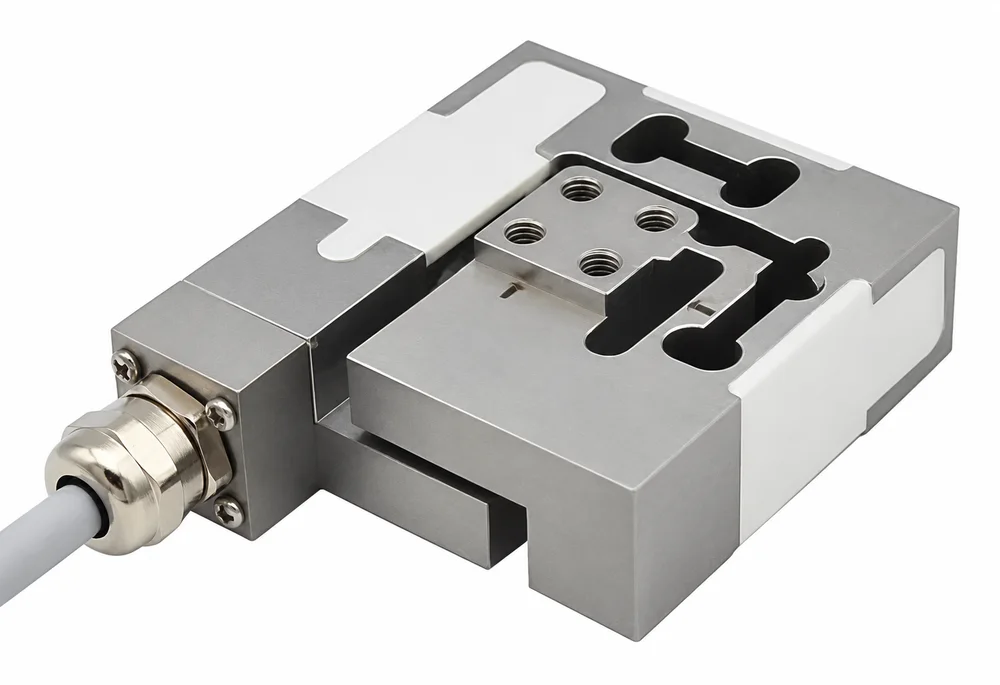
Architecture images support orientation, not dimensions.
What makes a useful shortlist?
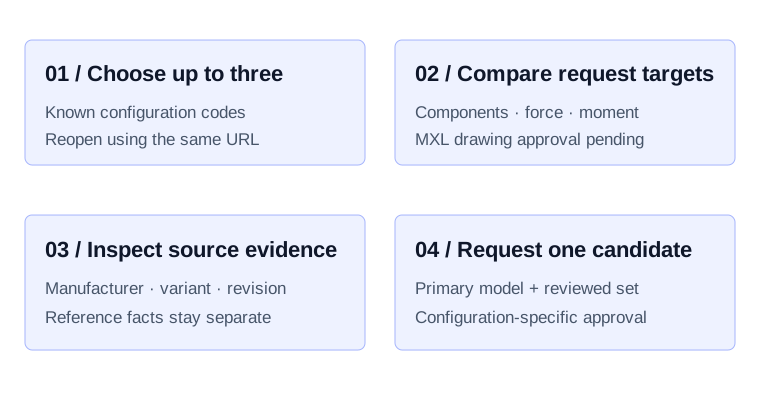
Resolve four questions with the quote.
- Which force and moment components must be measured, and which unmeasured components can still load the sensor?
- What simultaneous loads, tool offsets and mounting constraints occur in the actual application?
- Which calibration, synchronous acquisition and controller interface must the supplied package support?
- Which drawing revision, evidence and commercial deliverables define the offer?
Interface’s selection guide organizes the task by measured axes, mechanical features and options. HBK’s load-analysis guide explains why signed load cases and sensor-specific limits also matter. Those are methodology references, not MXL hardware approvals.
Comparison questions
Are these approved MXL product specifications?
No. MXL capacity rows describe configuration requests, and MXL dimensions remain subject to drawing review. A verified manufacturer-reference row describes that manufacturer and revision only.
Can the comparison tell me which model fits my application?
It helps identify measured-component differences, request targets and missing evidence. Installation, noise, calibration and simultaneous-load suitability still require a configuration-specific engineering review.
Why are the legacy 3A60 and revised 3A60A separate candidates?
The legacy and revised Interface mounting patterns must be reviewed separately. Similar range targets and a shared family name do not establish a compatible mounting interface.
Can I compare three-force and six-component configurations?
Yes. The page identifies differing measured components rather than treating them as equivalent alternatives. Choose a primary request and include unresolved moment or force requirements in the application notes.
What is included when I request one candidate?
The RFQ selects that primary model and includes the reviewed candidate set as a separate context block, with requested targets, reference source revisions and approval boundaries. You can edit or remove that context.
Can I use or share this comparison without JavaScript?
Yes. Native selectors submit published model IDs in the URL, and the comparison is rendered on the server. The contact page also provides a native email template.